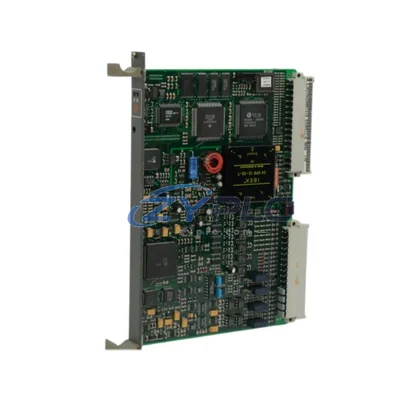
Woodward 8440-2051 Control for 8440 Series
The Woodward 8440-2051 is a purpose-engineered genset control module designed to operate as a central node within the 8440 Series control architecture. Rather than functioning as a standalone device, the 8440-2051 is conceived as a system-level component — one that coordinates signal acquisition, engine protection logic, governor response, and generator output regulation across a unified control platform. In distributed power generation environments, where system consistency, fault tolerance, and long-term maintainability are non-negotiable, the 8440-2051 delivers the architectural coherence that modern industrial facilities demand.
Within a complete genset control system, the 8440-2051 occupies the supervisory control layer, interfacing directly with speed sensing inputs, analog measurement circuits, digital I/O modules, and communication gateways. Its role is to translate real-time engine and generator data into actionable control outputs — governing fuel delivery, managing load sharing, and enforcing protective relay logic — all within a deterministic scan cycle that ensures predictable system behavior under variable load conditions.
The module’s system integration capability allows it to synchronize operational parameters with upstream SCADA systems, maintenance planning platforms, and remote monitoring terminals without requiring custom middleware. This native interoperability reduces commissioning time and eliminates the protocol translation overhead that often introduces latency in time-critical protection sequences.
Product Specification Table
| Parameter |
Specification |
| System Role |
Genset Supervisory Control Module — 8440 Series Architecture |
| SKU / Part Number |
8440-2051 |
| Brand |
Woodward |
| Series |
8440 Series |
| Product Type |
Genset Control Module |
| Control Functions |
Speed governing, voltage regulation, load sharing, protective relay logic |
| Analog Inputs |
Multi-channel analog acquisition (voltage, current, frequency, temperature) |
| Digital I/O |
Configurable discrete input/output channels for alarm, trip, and status signals |
| Communication Capability |
Serial and network-based communication; compatible with Modbus RTU/TCP protocols |
| Power Supply Compatibility |
24 VDC nominal; wide-range input tolerance for industrial panel environments |
| Installation Environment |
Control cabinet / genset panel; DIN rail or panel-mount compatible |
| Operating Temperature |
-40°C to +70°C (industrial grade) |
| Origin |
United States |
| Warranty |
— covers functional defects under normal operating conditions |
| Availability |
RFQ Available; tested prior to shipment |
System Compatibility Notes
The 8440-2051 achieves its full performance potential when integrated within a coordinated system architecture that spans multiple functional layers. At the control layer, it works in conjunction with Woodward’s governor actuators and digital voltage regulators (DVRs) to maintain engine speed and terminal voltage within tight tolerances during load transients. The module’s internal PID algorithms are tuned to complement the response characteristics of Woodward actuator families, ensuring that speed droop and isochronous load sharing operate without hunting or instability.
At the I/O layer, the 8440-2051 interfaces with discrete input modules and analog signal conditioners that aggregate data from engine sensors — including magnetic pickup units (MPUs) for speed sensing, current transformers (CTs) for load measurement, and resistance temperature detectors (RTDs) for thermal monitoring. These signals feed directly into the module’s protection logic, enabling automatic shutdown sequences for conditions such as overspeed, overcurrent, high coolant temperature, and low oil pressure.
For network-layer integration, the 8440-2051 supports communication with Modbus-compatible SCADA terminals, remote annunciator panels, and plant-level maintenance planning systems. In multi-genset installations, the module participates in load sharing networks alongside companion units such as the Woodward 8440-2052 or 8440-2053, coordinating real and reactive power distribution across parallel generators without requiring a central arbitration controller.
At the power layer, the module is designed to operate from a regulated 24 VDC bus, compatible with industrial power supplies and UPS-backed distribution panels. Its low quiescent current draw ensures that battery-backed systems maintain adequate reserve capacity during extended standby periods. The module’s internal watchdog circuit provides an additional layer of protection against firmware lockup, automatically initiating a controlled restart sequence if the main processor fails to complete its scan cycle within the defined timeout window.
For human-machine interface (HMI) integration, the 8440-2051 exposes a structured data map that is directly readable by Woodward’s operator panels and third-party HMI terminals supporting Modbus register addressing. Alarm status, setpoint values, measured parameters, and control mode selections are all accessible through the communication interface, enabling operators to monitor and adjust system behavior without physical access to the control cabinet. In facilities where remote diagnostics are required, the module’s data map can be polled by supervisory systems at configurable intervals, supporting both real-time monitoring and historical data logging.
Industrial Application Notes
The Woodward 8440-2051 is deployed across a broad range of industrial sectors where reliable power generation and precise engine control are critical to operational continuity.
In manufacturing and process industries, the module serves as the primary control interface for standby and prime power gensets that support continuous production lines. Its fast load acceptance capability ensures that critical machinery — including CNC machining centers, injection molding presses, and conveyor drive systems — experience minimal voltage and frequency deviation during utility transfer events.
In electric power utilities and substations, the 8440-2051 is integrated into emergency diesel generator (EDG) systems that provide backup power for protection relay panels, communication equipment, and control room instrumentation. The module’s protective relay logic is configured to coordinate with upstream overcurrent relays and bus transfer schemes, ensuring that the EDG connects to the emergency bus only when voltage and frequency are within acceptable limits.
In oil, gas, and petrochemical facilities, the module controls gas-fueled generator sets operating in hazardous area classifications. Its robust signal isolation and wide operating temperature range make it suitable for installation in outdoor generator enclosures and remote wellhead power systems where environmental conditions are demanding.
In water and wastewater treatment plants, the 8440-2051 manages standby generators that power pumping stations, aeration blowers, and SCADA communication infrastructure. The module’s load shedding outputs can be configured to prioritize critical loads during generator startup, ensuring that essential treatment processes remain operational during utility outages.
In mining and metallurgical operations, the module is deployed in mobile and fixed generator sets that power ventilation fans, hoisting equipment, and ore processing machinery. Its ability to operate across a wide ambient temperature range and tolerate high levels of electrical noise makes it well-suited to the demanding electromagnetic environment of mining facilities.
Product Compatibility FAQ
Q1: Is the Woodward 8440-2051 compatible with existing 8440 Series control panels and backplane assemblies?
A: Yes. The 8440-2051 is designed as a native component of the 8440 Series architecture and is fully compatible with existing 8440 Series control panels, terminal blocks, and wiring harnesses. No hardware modifications are required for direct replacement of a like-for-like unit. For system upgrades involving firmware version changes, it is recommended to verify parameter compatibility using Woodward’s configuration software before commissioning the replacement module.
Q2: What communication protocols does the 8440-2051 support, and how does it integrate with third-party SCADA systems?
A: The 8440-2051 supports Modbus RTU over RS-485 as its primary communication protocol, with optional Modbus TCP/IP capability depending on the specific hardware revision. Integration with third-party SCADA systems is achieved by mapping the module’s internal register addresses to the SCADA system’s tag database. The module’s register map is documented in Woodward’s technical manual for the 8440 Series, and standard Modbus polling intervals of 100–500 ms are sufficient for real-time monitoring applications. For facilities requiring OPC-DA or OPC-UA connectivity, a Modbus-to-OPC gateway device can be inserted between the module and the SCADA server without affecting control performance.
Q3: What does the cover, and what support is available for long-term maintenance?
A: The covers all functional defects attributable to manufacturing or component quality issues under normal operating conditions. It does not cover damage resulting from incorrect installation, overvoltage events, or operation outside the specified environmental limits. For long-term maintenance, ZYPLC maintains a stock of tested 8440-2051 units to support rapid replacement in the event of field failures. Our technical team can assist with parameter backup, module configuration, and commissioning verification to minimize system downtime during scheduled maintenance intervals.