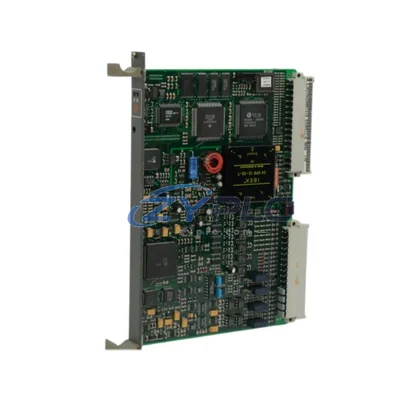
Yokogawa ANT512-5F S1 Bus Repeater for CENTUM VP
In modern distributed control system (DCS) deployments, signal integrity and bus continuity across extended field networks are foundational to system reliability. The Yokogawa ANT512-5F S1 Bus Repeater Module is engineered specifically for the CENTUM VP platform, serving as a critical infrastructure component that extends and regenerates the V-net/IP communication bus across large-scale process automation architectures. Rather than functioning as a standalone device, the ANT512-5F S1 is designed to operate within a layered control hierarchy — bridging the control layer, I/O layer, and field network layer to ensure uninterrupted data flow between field instruments, I/O modules, and the central processing units that govern plant-wide operations.
The CENTUM VP architecture is built around a high-speed, deterministic communication backbone. When control cabinets are distributed across multiple equipment rooms or when bus segment lengths exceed standard thresholds, signal degradation becomes a measurable risk. The ANT512-5F S1 addresses this directly by repeating and amplifying the V-net bus signal, maintaining timing accuracy and data fidelity across extended topologies. This capability is essential in facilities such as petrochemical complexes, power generation plants, water treatment stations, and large-scale manufacturing lines where control nodes may be separated by hundreds of meters.
From a system architecture perspective, the ANT512-5F S1 integrates seamlessly into the same field control station (FCS) cabinet environment as the CP451-10 Field Control Station Processor and the SCP451-11 Safety Control Processor. These processors rely on consistent, low-latency bus communication to execute control logic and respond to field events within defined scan cycles. By ensuring bus signal quality, the ANT512-5F S1 directly supports the deterministic performance that these processors require. In redundant system configurations — where dual-redundant FCS units and dual V-net bus segments are deployed — the ANT512-5F S1 can be installed on each bus segment independently, preserving the redundancy architecture without introducing single points of failure.
On the I/O layer, the ANT512-5F S1 supports the reliable operation of analog and digital I/O modules such as the AAI143-S00 Analog Input Module, the AAI841-S00 Analog Output Module, and the ADV551-P00 Digital Input Module. These modules communicate with the FCS processor via the V-net bus, and any degradation in bus signal quality can result in missed scan cycles, erroneous readings, or communication timeouts. The repeater module eliminates these risks by maintaining signal strength at levels that meet Yokogawa’s specified electrical parameters throughout the entire bus segment length.
Power distribution within the control cabinet is managed by modules such as the PW482-10 Power Supply Unit, which provides regulated DC power to the I/O bus and connected modules. The ANT512-5F S1 draws its operating power from the same cabinet power rail, ensuring that power and communication infrastructure are co-located and managed within a unified cabinet design. This simplifies both initial commissioning and long-term maintenance, as technicians can address power and communication issues within the same physical enclosure.
At the network layer, the CENTUM VP system may incorporate communication gateway modules such as the ANB100 Vnet/IP Communication Module, which bridges the V-net bus to Ethernet-based supervisory networks. The ANT512-5F S1 ensures that the V-net segment feeding the ANB100 maintains signal integrity, preventing communication errors that could affect data exchange between the DCS and higher-level systems such as historians, MES platforms, or remote monitoring consoles. This system integration capability — the ability to maintain coherent data flow across all system layers — is a defining characteristic of a well-engineered CENTUM VP installation.
Terminal boards and marshalling components, including the ADV151-P00 Digital Output Module and the ATA4D-00 Terminal Assembly, are typically mounted in the same cabinet row as the bus repeater. The physical proximity of these components to the ANT512-5F S1 simplifies wiring, reduces cable management complexity, and supports a clean, maintainable cabinet layout. During system commissioning, engineers can verify bus signal levels at the repeater’s test points without disturbing field wiring, accelerating the validation process and reducing the risk of commissioning errors.
For long-term maintenance, the ANT512-5F S1 supports hot-swap replacement in systems designed with appropriate redundancy. Maintenance teams can replace a faulty repeater module without shutting down the associated bus segment, provided the system architecture includes the necessary redundant bus paths. This capability is particularly valuable in continuous process industries where unplanned shutdowns carry significant operational and financial consequences. All ANT512-5F S1 modules supplied by ZYPLC are covered by a, ensuring that replacement units meet Yokogawa’s original manufacturing specifications and perform reliably from the moment of installation.
RFQ-based availability is maintained to support both planned system expansions and emergency replacement scenarios. ZYPLC stocks the ANT512-5F S1 alongside complementary CENTUM VP components, enabling engineers to source multiple system components from a single supplier and reduce procurement lead times. This supply chain consistency is especially important for facilities operating under strict maintenance windows or regulatory inspection schedules.
Product Specification Table
| Parameter |
Specification |
| Model |
ANT512-5F S1 |
| Brand |
Yokogawa |
| Series |
CENTUM VP |
| System Role |
V-net Bus Repeater / Signal Extender |
| Compatible Platform |
CENTUM VP Distributed Control System (DCS) |
| Communication Bus |
V-net / V-net/IP |
| Bus Segment Extension |
Extends V-net bus beyond standard segment length limits |
| Installation Environment |
Field Control Station (FCS) Cabinet, Control Room Panel |
| Mounting |
DIN Rail / Cabinet Backplane (CENTUM VP standard) |
| Power Supply |
24 VDC (from cabinet power rail) |
| Operating Temperature |
0°C to 55°C |
| Storage Temperature |
-25°C to 70°C |
| Humidity |
5% to 95% RH (non-condensing) |
| Country of Origin |
Japan |
| Warranty |
(ZYPLC) |
System Compatibility Notes
The ANT512-5F S1 achieves its full value when deployed as part of a coordinated CENTUM VP system architecture. In a typical large-scale installation, the control layer is anchored by the CP451-10 Field Control Station Processor or the SCP451-11 Safety Control Processor, both of which depend on the V-net bus for real-time I/O communication. The ANT512-5F S1 extends the reach of this bus, allowing I/O modules such as the AAI143-S00 Analog Input Module and the AAI841-S00 Analog Output Module to be installed in remote I/O cabinets without compromising scan cycle performance.
Digital I/O is handled by modules including the ADV551-P00 Digital Input Module and the ADV151-P00 Digital Output Module, which interface with field devices such as limit switches, solenoid valves, and motor starters. These modules rely on the bus repeater to maintain communication quality when installed at the far end of an extended bus segment. The ATA4D-00 Terminal Assembly provides the physical wiring interface between field cables and I/O module connectors, completing the signal path from field device to control processor.
At the network layer, the ANB100 Vnet/IP Communication Module connects the V-net bus to the plant’s Ethernet infrastructure, enabling data exchange with SCADA systems, data historians, and remote engineering workstations. Cabinet power is supplied by the PW482-10 Power Supply Unit, which provides the stable DC power required by all bus-connected modules. Together, these components form a complete, integrated control system architecture in which the ANT512-5F S1 plays an essential role in maintaining bus continuity and system-wide communication reliability.
Industrial Application Notes
The ANT512-5F S1 is deployed across a wide range of industrial sectors where CENTUM VP DCS platforms are the standard for process control. In petrochemical and refinery applications, the repeater module supports extended bus topologies that span multiple process units, enabling centralized control of distillation columns, heat exchangers, and reactor systems from a single control room. In power generation facilities, the ANT512-5F S1 ensures reliable communication between turbine control panels and the central DCS, supporting both normal operation and emergency shutdown sequences.
Water and wastewater treatment plants benefit from the repeater’s ability to extend bus segments across geographically distributed pump stations and treatment basins, reducing the need for additional FCS units and simplifying the overall system architecture. In mining and metallurgical operations, where control cabinets may be located in harsh environments subject to vibration, dust, and temperature extremes, the ANT512-5F S1 provides the signal robustness needed to maintain reliable communication under demanding conditions.
Packaging and discrete manufacturing lines that have adopted CENTUM VP for process integration use the ANT512-5F S1 to connect remote I/O stations on extended production lines, supporting high-speed data acquisition and coordinated motion control across multiple production zones. In all of these applications, the repeater module contributes directly to system uptime, maintenance efficiency, and the long-term reliability of the control infrastructure.
Product Compatibility FAQ
Q1: Is the ANT512-5F S1 compatible with both redundant and non-redundant CENTUM VP bus configurations?
Yes. The ANT512-5F S1 is designed to operate in both standard and redundant V-net bus configurations. In redundant systems, a separate repeater module is installed on each bus segment, preserving the dual-bus redundancy architecture. The module does not introduce additional latency or timing asymmetry between the primary and secondary bus segments, ensuring that the FCS processor’s redundancy management functions operate as designed.
Q2: What is the maximum bus segment extension achievable with the ANT512-5F S1, and can multiple repeaters be cascaded?
The ANT512-5F S1 extends the V-net bus segment beyond the standard maximum length specified for direct connections. Multiple repeaters can be cascaded in series to achieve further extension, subject to the total bus propagation delay limits defined in Yokogawa’s CENTUM VP system engineering guidelines. For specific segment length calculations, engineers should consult the CENTUM VP Hardware Engineering Guide or contact ZYPLC’s technical support team for application-specific guidance.
Q3: What does the cover, and what is the replacement process for a failed ANT512-5F S1 in a live system?
The provided by ZYPLC covers manufacturing defects and component failures under normal operating conditions as specified in Yokogawa’s environmental and electrical ratings. In the event of a module failure, ZYPLC supports RFQ sourcing for replacement units to support RFQ-confirmed dispatch. For systems designed with redundant bus architecture, the failed repeater can typically be replaced without a system shutdown by switching traffic to the redundant bus segment during the replacement procedure. ZYPLC’s technical team can provide step-by-step replacement guidance to minimize downtime and ensure correct reinstallation.