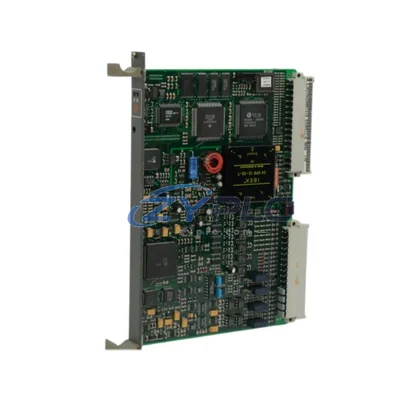
Yokogawa SDV531-L33 S3 Signal Validation for CENTUM VP
The Yokogawa SDV531-L33 S3 is a precision signal validation module engineered for seamless integration within the CENTUM VP distributed control system architecture. Rather than functioning as a standalone component, this module occupies a critical position in the signal conditioning and data integrity layer of a multi-tier automation hierarchy — bridging field instrumentation with the process control domain to ensure that every measurement entering the control loop is verified, conditioned, and trustworthy before it influences any regulatory or supervisory decision.
In modern industrial automation, the reliability of a control system is only as strong as the integrity of its input signals. The SDV531-L33 S3 addresses this fundamental requirement by providing hardware-level signal validation directly at the I/O layer, reducing the computational burden on the CPU module — such as the Yokogawa CP451-10 or CP461-50 — and enabling faster scan cycles across the entire CENTUM VP node. This architectural efficiency is particularly valuable in high-density process environments where hundreds of analog loops must be monitored simultaneously without latency or data corruption.
The module is designed to mount directly onto Yokogawa-compatible I/O nest assemblies, including the ANB10D and ANB10S nest units, and communicates over the internal V-net/IP or ESB bus depending on the system generation. This tight hardware integration ensures deterministic signal timing and eliminates the jitter that can arise from software-based validation routines running on shared processor resources. When paired with the Yokogawa AIP588 or AAI141-S00 analog input modules, the SDV531-L33 S3 creates a validated signal chain from the field transmitter all the way to the historian and HMI layer.
Product Specification Table
| Parameter |
Specification |
| System Role |
Signal Validation Module — I/O Conditioning Layer |
| Compatible Platform |
Yokogawa CENTUM VP (R4.x / R5.x / R6.x) |
| Module Series |
SDV531 Series (L33 Variant, S3 Suffix) |
| Signal Types Supported |
4–20 mA analog, HART-compatible field devices |
| Validation Channels |
Up to 16 channels per module (configuration-dependent) |
| Communication Interface |
ESB Bus / V-net/IP (platform generation dependent) |
| Power Supply Requirement |
24 VDC (supplied via I/O nest backplane) |
| Operating Temperature |
0°C to 55°C (32°F to 131°F) |
| Humidity Range |
5% to 95% RH, non-condensing |
| Mounting |
ANB10D / ANB10S I/O Nest (DIN rail or panel mount) |
| Isolation |
Channel-to-channel and channel-to-bus isolation |
| Certifications |
CE, UL, IECEx (application-dependent) |
| Country of Origin |
Japan |
| Warranty |
— covers manufacturing defects and functional failure under normal operating conditions |
System Compatibility Notes
The SDV531-L33 S3 achieves its full potential when deployed as part of a coordinated CENTUM VP control node rather than as an isolated replacement part. In a typical process control cabinet, the module works in concert with the Yokogawa CP451-10 field control station CPU, which handles PID regulation and sequence logic, while the SDV531-L33 S3 ensures that the analog inputs feeding those control algorithms are continuously validated against configurable engineering limits and rate-of-change thresholds.
On the power supply side, the Yokogawa PW481 or PW482 redundant power supply modules provide the stable 24 VDC rail that the I/O nest — and by extension the SDV531-L33 S3 — depends on for uninterrupted operation. In safety-critical applications such as oil and gas separation trains or chemical reactor control, a dual-redundant power architecture is standard practice, and the SDV531-L33 S3 is fully compatible with this configuration without requiring additional isolation hardware.
For network connectivity, the CENTUM VP system typically employs the Yokogawa ACG10S or ACG30S Vnet/IP communication gateway modules to bridge field control stations with the supervisory layer. The SDV531-L33 S3 contributes to network stability by reducing spurious alarms and bad-quality signal propagation — a common source of nuisance trips that can cascade through the control network and trigger unnecessary shutdowns. By validating signals at the source, the module helps maintain clean data on the Vnet/IP backbone, improving the reliability of the Yokogawa FAST/TOOLS SCADA or Exaquantum historian that aggregates process data plant-wide.
At the human-machine interface layer, operators working on Yokogawa HIS (Human Interface Station) consoles benefit directly from the SDV531-L33 S3’s validation capability. When a field transmitter begins to drift or fail, the module flags the signal as suspect before it reaches the HIS display, allowing operators to take corrective action based on accurate status information rather than reacting to false process deviations. This system integration between the I/O validation layer and the HMI presentation layer is a defining characteristic of well-engineered CENTUM VP architectures.
In redundant controller configurations, the SDV531-L33 S3 supports bumpless switchover by maintaining consistent signal quality data across both the primary and standby CP451-10 or CP461-50 processors. This ensures that when a controller failover occurs — whether planned or unplanned — the incoming controller receives validated, high-quality signal data from the first scan cycle, eliminating the transient disturbances that can occur when a standby controller inherits degraded or unvalidated input data.
Industrial Application Notes
The SDV531-L33 S3 is deployed across a wide range of process industries where signal integrity is non-negotiable. In petroleum refining and petrochemical complexes, the module is commonly installed in crude distillation unit control panels, where temperature and pressure signals from hundreds of thermocouples and pressure transmitters must be continuously validated to prevent unsafe operating conditions. The module’s ability to detect sensor drift, open-circuit faults, and out-of-range conditions in real time makes it an essential component of the safety instrumented layer that complements the basic process control system.
In electric power generation and grid management facilities, the SDV531-L33 S3 supports turbine control and boiler management systems where millisecond-level signal accuracy is required for load-following and frequency regulation. The module’s deterministic validation cycle ensures that control actions are based on verified measurements, reducing the risk of turbine trips caused by spurious sensor readings.
Water and wastewater treatment plants operating under strict regulatory compliance requirements use the SDV531-L33 S3 to validate flow, pH, and dissolved oxygen signals that directly influence dosing control loops. In these applications, a single bad-quality signal propagating to a PID controller can result in over- or under-dosing events with significant environmental and regulatory consequences. The module’s system integration with the CENTUM VP alarm management system ensures that signal quality events are logged, timestamped, and traceable for compliance reporting.
In mining and mineral processing operations, where vibration, dust, and temperature extremes challenge instrumentation reliability, the SDV531-L33 S3 provides an additional layer of signal conditioning that extends the effective service life of field transmitters by compensating for environmental degradation before it affects control performance. Metallurgical plants processing copper, aluminum, or iron ore benefit from the module’s ability to maintain consistent control loop performance even as field conditions deteriorate between scheduled maintenance intervals.
Packaging and discrete manufacturing lines using CENTUM VP for coordinated motion and process control also benefit from the SDV531-L33 S3 in applications where analog feedback from servo drives, tension controllers, and web-guiding systems must be validated before being used in cross-machine synchronization algorithms.
Product Compatibility FAQ
Q1: Is the SDV531-L33 S3 compatible with both older CENTUM VP R4.x systems and current R6.x installations?
The SDV531-L33 S3 is designed for the CENTUM VP platform and is generally compatible across R4.x through R6.x system generations, subject to the specific I/O nest type and ESB bus configuration in use. For R4.x systems using ANB10D nests, the module slots directly into the existing nest without hardware modification. For R6.x systems with updated backplane architectures, compatibility should be confirmed against the Yokogawa hardware compatibility matrix for the specific FCS (Field Control Station) model in use. Our technical team can assist with pre-installation compatibility verification as part of the support package.
Q2: How does the SDV531-L33 S3 support long-term maintenance and reduce downtime in continuous process plants?
The module supports predictive maintenance workflows by providing continuous signal quality diagnostics that can be trended in the Exaquantum historian or exported to third-party asset management systems via OPC-DA or OPC-UA interfaces. By tracking signal degradation trends over time, maintenance engineers can schedule transmitter replacements during planned turnarounds rather than responding reactively to sudden failures. The covers the module itself, and our inventory supply chain ensures that replacement units are available for RFQ-confirmed dispatch to minimize any downtime events.
Q3: What installation and commissioning considerations apply when integrating the SDV531-L33 S3 into an existing CENTUM VP architecture?
Installation requires the CENTUM VP engineering environment (System View or Control Drawing Builder) to configure channel assignments, validation limits, and alarm thresholds. The module should be installed with the FCS in maintenance mode to prevent spurious control actions during the configuration download. Grounding and shielding of field wiring to the I/O nest terminals must comply with Yokogawa’s EMC guidelines to prevent common-mode noise from affecting validation accuracy. Post-installation, a loop check procedure should be performed for each channel to verify that the validation thresholds are correctly aligned with the process operating range. All commissioning support is covered under the service terms.