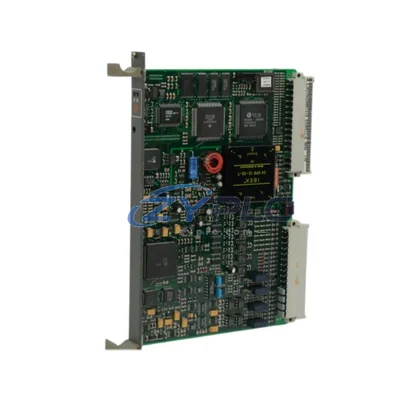
Yokogawa SDV541-S33/S2 Signal Conditioner for CENTUM VP
The Yokogawa SDV541-S33/S2 is a high-precision signal conditioner engineered to serve as a critical interface module within the CENTUM VP distributed control system architecture. Designed for seamless system integration into layered automation environments, this module bridges the gap between field-level instrumentation and the control processing layer, ensuring that analog signals are conditioned, scaled, and transmitted with exceptional fidelity across the entire signal chain.
Within a fully configured CENTUM VP system, the SDV541-S33/S2 operates at the I/O layer, receiving raw analog signals from field transmitters, thermocouples, RTDs, and other sensing devices. It performs essential signal conditioning functions including amplification, filtering, isolation, and linearization before passing clean, standardized signals to the field control station. This role is indispensable in maintaining measurement accuracy and protecting upstream control processors from electrical noise, ground loops, and transient voltage spikes that are common in heavy industrial installations.
Product Specification Table
| Parameter |
Specification |
| Model / SKU |
SDV541-S33/S2 |
| Manufacturer |
Yokogawa Electric Corporation |
| System Role |
Analog Signal Conditioner — I/O Layer Interface |
| Compatible Platform |
CENTUM VP Distributed Control System |
| Signal Type |
Analog Input Conditioning (4–20mA, 1–5V, TC, RTD) |
| Isolation |
Channel-to-channel and channel-to-bus galvanic isolation |
| Communication Bus |
ESB (Enhanced Sensor Bus) to FCS via V-net |
| Mounting |
DIN-rail or dedicated I/O nest on CENTUM VP node |
| Power Supply |
Supplied via system backplane or dedicated 24VDC rail |
| Operating Temperature |
-20°C to +55°C |
| Origin |
Japan |
| Warranty |
warranty terms confirmed during quotation |
System Compatibility Notes
The SDV541-S33/S2 does not function in isolation. Its value is realized when deployed as part of a coordinated CENTUM VP control architecture where every layer — from field sensing to supervisory control — operates in concert. At the heart of this architecture sits the field control station, such as the Yokogawa AFV30D or AFV40D, which executes real-time PID control loops and sequential logic. The SDV541-S33/S2 feeds conditioned analog data directly into these processors, enabling precise closed-loop control of temperature, pressure, flow, and level variables.
Power integrity across the I/O layer is maintained by dedicated power supply modules like the Yokogawa PW482-10, which delivers regulated DC power to signal conditioning cards and field terminal assemblies. Without stable power conditioning, even the most accurate signal conditioner would be susceptible to measurement drift and spurious readings.
On the communication backbone, the CENTUM VP system relies on V-net — Yokogawa’s proprietary redundant control network — to transport data between field control stations, engineering workstations, and the human-machine interface layer. The Yokogawa AIP827 communication interface card facilitates this connectivity, ensuring deterministic data exchange with sub-millisecond latency across the entire control domain.
For installations requiring high-density analog input acquisition, the SDV541-S33/S2 is typically deployed alongside companion modules such as the Yokogawa AAI143-H00 analog input module and the AAI543-H00 analog output module. Together, these modules form a complete analog signal processing subsystem capable of handling hundreds of field signals within a single I/O nest.
Terminal interface units such as the Yokogawa SCP461-11 provide the physical wiring termination between field cables and the signal conditioning modules. Proper termination is essential for maintaining signal integrity, especially in environments with long cable runs or significant electromagnetic interference.
At the supervisory level, the Yokogawa HIS (Human Interface Station) running on platforms such as the Yokogawa TDCS3000 provides operators with real-time visualization of all conditioned signals, alarm management, and trend analysis. The accuracy of every displayed value depends on the signal conditioning quality delivered by modules like the SDV541-S33/S2.
For systems requiring redundancy, the CENTUM VP architecture supports dual-redundant FCS configurations where paired field control stations and their associated I/O modules — including signal conditioners — operate in hot-standby mode. The Yokogawa SSB401-10 bus interface module enables seamless switchover between primary and backup controllers, ensuring zero data loss during failover events.
Industrial Application Notes
The SDV541-S33/S2 finds its primary applications in process industries where measurement precision and system reliability are non-negotiable. In petrochemical refining operations, this signal conditioner processes thermocouple inputs from reactor temperature monitoring points, ensuring that exothermic reaction temperatures are tracked with sub-degree accuracy for safe and efficient catalyst management.
In power generation facilities, particularly combined-cycle gas turbine plants, the SDV541-S33/S2 conditions vibration sensor outputs and bearing temperature signals that feed into the turbine protection system. Any degradation in signal quality at this layer could result in delayed trip responses, making the conditioning module a safety-critical component.
Water and wastewater treatment plants leverage the SDV541-S33/S2 to process pH, dissolved oxygen, and turbidity sensor signals. These measurements drive chemical dosing control loops where signal accuracy directly impacts treatment efficacy and regulatory compliance.
In metallurgical processing — including steel rolling mills and aluminum smelting operations — the module conditions load cell and pyrometer signals used in thickness control and temperature regulation systems. The harsh electromagnetic environment of these facilities demands the robust galvanic isolation that the SDV541-S33/S2 provides.
Mining and mineral processing operations deploy this signal conditioner in grinding circuit control systems, where mill weight, ore feed rate, and slurry density signals must be conditioned with high precision to optimize throughput and operating load.
Pharmaceutical manufacturing and food processing facilities benefit from the module’s ability to maintain calibrated signal paths that satisfy GMP documentation requirements and FDA 21 CFR Part 11 traceability standards.
Regardless of the application sector, the SDV541-S33/S2 contributes to long-term system maintainability by providing standardized, hot-swappable signal conditioning that reduces mean time to repair. Field technicians can replace a faulty module without disrupting adjacent channels or requiring a full system shutdown — a critical advantage in continuous process operations.
ZYPLC maintains ready stock of the SDV541-S33/S2 with full traceability documentation and a warranty terms confirmed during quotation, supporting rapid deployment for both new system builds and like-for-like replacement in existing CENTUM VP installations worldwide.
Product Compatibility FAQ
Q1: Is the SDV541-S33/S2 compatible with older CENTUM CS 3000 systems, or is it exclusive to CENTUM VP?
The SDV541-S33/S2 is primarily designed for the CENTUM VP platform. However, Yokogawa has maintained a degree of backward compatibility across its DCS generations. When migrating from CENTUM CS 3000 to CENTUM VP, many I/O modules including signal conditioners can be reused provided the backplane and field control station support the module’s bus protocol. It is recommended to verify compatibility with the specific FCS hardware revision and system software version before deployment. ZYPLC technical support can assist with compatibility verification as part of our warranty terms confirmed during quotation service.
Q2: How does the SDV541-S33/S2 integrate with third-party SCADA systems or non-Yokogawa controllers?
While the SDV541-S33/S2 is natively designed for the CENTUM VP ecosystem, the conditioned signals it produces can be made available to third-party systems through Yokogawa’s OPC-UA gateway or Modbus TCP interface modules. This system integration approach allows plant operators to incorporate Yokogawa I/O subsystems into hybrid control architectures without sacrificing signal quality or introducing additional conversion errors.
Q3: What maintenance and calibration schedule is recommended for the SDV541-S33/S2 in continuous operation?
Yokogawa recommends a calibration verification interval of 12 to 24 months depending on the criticality of the measurement loop and the environmental conditions. The module’s self-diagnostic capabilities — accessible through the CENTUM VP engineering workstation — provide real-time health monitoring including channel deviation alerts and power supply status. Routine maintenance involves visual inspection of terminal connections, verification of isolation resistance, and comparison of conditioned output against known reference standards. All modules supplied by ZYPLC include a warranty terms confirmed during quotation covering manufacturing defects and performance degradation under normal operating conditions.