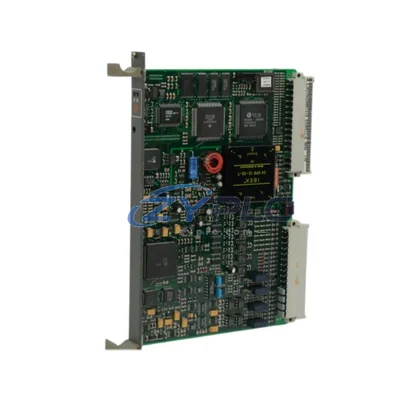
Yokogawa SNT521-53 Bus Repeater for Centum Automation
The Yokogawa SNT521-53 is a high-performance bus repeater slave module engineered for the Centum VP distributed control system (DCS) platform. In modern industrial facilities where energy efficiency and process reliability are non-negotiable, the SNT521-53 plays a critical role in maintaining clean, low-loss signal transmission across field bus segments — directly reducing the electrical overhead associated with signal degradation, retransmission errors, and unplanned downtime.
As manufacturing plants push toward leaner energy consumption targets, every component in the control architecture must justify its power draw through measurable process value. The SNT521-53 achieves this by acting as a precision signal bridge between the Centum VP controller bus and remote I/O nodes, ensuring that field devices — from analog input modules like the AAI543-H00 to digital output cards such as the ADV551-P00 — receive clean, stable communication signals without requiring redundant polling cycles that waste CPU cycles and bus bandwidth.
Product Specification Table
| Parameter |
Specification / Value |
| SKU / Part Number |
SNT521-53 |
| Product Type |
Bus Repeater Slave Module |
| Compatible Platform |
Yokogawa Centum VP DCS |
| Series |
Centum VP / CS3000 |
| Origin |
Japan |
| Bus Interface |
Vnet/IP, ESB (Enhanced Signal Bus) |
| Power Consumption |
Low-draw design; optimized for minimal bus load |
| Operating Environment |
Industrial control rooms, DCS cabinets, process plants |
| Application Sectors |
Oil & Gas, Petrochemical, Power Generation, Pharmaceuticals |
| Maintenance Value |
Reduces signal retries, lowers CPU polling overhead, extends field device lifespan |
| Availability |
Confirmed via RFQ before quotation |
| Quality Assurance |
Outgoing shipment test performed on every unit |
| Warranty |
Warranty and support terms confirmed before quote |
System Compatibility and Application
The SNT521-53 does not operate in isolation — it is a foundational element within a broader industrial automation system. In a typical Centum VP installation, the system controller unit CP451-10 manages process logic and communicates with field I/O through the enhanced signal bus. When bus segments extend across large plant areas, signal integrity degrades, forcing controllers to increase polling frequency and error-correction overhead. The SNT521-53 eliminates this inefficiency by regenerating and repeating bus signals at full strength, allowing the CP451-10 to maintain optimal scan rates without compensating for line attenuation.
On the power monitoring side, integrating the SNT521-53 with Yokogawa’s WT series power analyzers or field-mounted power transducers enables real-time energy consumption tracking at the segment level. This data feeds into the plant’s maintenance planning layer, where operators can identify which bus segments or field devices are drawing anomalous power — a leading indicator of failing components before they cause unexpected shutdowns.
For drive-level energy control, the SNT521-53 supports communication with variable frequency drives (VFDs) connected through remote I/O nodes. When paired with Yokogawa’s AIP827 analog input module and motor control I/O cards, the system can monitor motor load curves in real time, enabling the DCS to issue speed-reduction commands during low-demand periods — directly cutting kWh consumption on pump and fan circuits without manual intervention.
Human-machine interface terminals such as the HIS (Human Interface Station) in the Centum VP environment display bus health metrics and energy KPIs sourced through the repeater network. Operators gain visibility into segment-level communication quality, allowing maintenance teams to schedule preventive actions during planned shutdowns rather than reacting to failures mid-production.
The SNT521-53 also supports integration with Yokogawa’s STARDOM FCN/FCJ autonomous controllers in hybrid architectures, where legacy field devices communicate through older bus protocols while newer segments run on Vnet/IP. This interoperability reduces the need for full system replacements, preserving capital investment while enabling incremental maintenance planning upgrades.
Additional components commonly deployed alongside the SNT521-53 include the AMM12C multi-point monitor module for analog signal aggregation, the ALR111 alarm module for fault event logging, and the SCP451 sequence control processor for batch process management. Together, these modules form a tightly integrated control fabric where the SNT521-53 ensures every node communicates reliably — the prerequisite for any meaningful maintenance planning strategy.
Maintenance and Replacement Notes
In refinery and petrochemical applications, distributed control systems manage hundreds of field loops simultaneously. A single degraded bus segment can force the controller to increase its error-recovery cycles, consuming additional processing power and introducing latency into control loops that govern critical energy-intensive equipment such as compressors, heat exchangers, and distillation column reboilers.
By deploying the Yokogawa SNT521-53 at strategic points along the field bus topology, plant engineers restore full signal integrity to extended segments. This directly reduces the controller’s error-handling overhead, freeing CPU capacity for tighter PID loop execution — which translates to more precise control of energy-intensive actuators and valves. Tighter control means less overshoot, less unplanned downtimed in correction cycles, and more stable process conditions that reduce raw material consumption per unit of output.
In pharmaceutical batch manufacturing, where production line rhythm (takt time) is tightly regulated, communication delays caused by bus signal degradation can desynchronize batch sequences, forcing operators to extend cycle times or repeat steps — both of which increase energy consumption per batch. The SNT521-53 eliminates this source of variability, helping production lines maintain their designed takt time with consistent energy expenditure per cycle.
From a predictive maintenance perspective, the SNT521-53 enables continuous bus health monitoring. Abnormal signal patterns detected at the repeater level can indicate developing faults in connected field devices — such as insulation breakdown in motor windings or drift in transmitter calibration — before these faults escalate into failures. Early detection reduces emergency maintenance costs, avoids energy-wasteful restart sequences, and extends the operational lifespan of expensive field instruments.
Every unit supplied by ZYPLC undergoes a full outgoing shipment test to verify bus communication performance, signal regeneration accuracy, and power draw within specification. This ensures that the SNT521-53 you receive performs identically to OEM standards from day one of installation, with no burn-in period required.
Product Sourcing FAQ
Q1: How does the SNT521-53 contribute to measurable operational stability in a Centum VP system?
By restoring full signal integrity on extended bus segments, the SNT521-53 eliminates the controller overhead associated with error recovery and retransmission. This reduces CPU load on the CP451-10 and allows PID loops to execute at their designed scan rates, enabling tighter control of energy-intensive field devices and reducing process variability that leads to excess energy consumption.
Q2: Is the SNT521-53 compatible with both Centum VP and legacy CS3000 systems?
Yes. The SNT521-53 is designed for the Centum VP platform and is also compatible with CS3000 architectures that share the same enhanced signal bus infrastructure. For hybrid environments incorporating STARDOM FCN/FCJ controllers, compatibility should be verified against the specific firmware revision of the host system.
Q3: What is the recommended replacement or upgrade path if the SNT521-53 is end-of-life in my system?
For systems requiring modernization, Yokogawa’s current Centum VP R6 platform offers updated bus repeater modules with enhanced diagnostics. ZYPLC can advise on compatible replacement options based on your existing cabinet configuration and bus topology. Contact our technical team for a system-specific recommendation.
Q4: What testing is performed before shipment, and what does the warranty and support terms confirmed before quote cover?
Every SNT521-53 unit undergoes a full functional test simulating real bus communication conditions before dispatch. The warranty and support terms confirmed before quote covers manufacturing defects and functional failures under normal operating conditions. Units that fail to perform to OEM specification within the warranty period are replaced or refunded. Contact ZYPLC for warranty claim procedures.