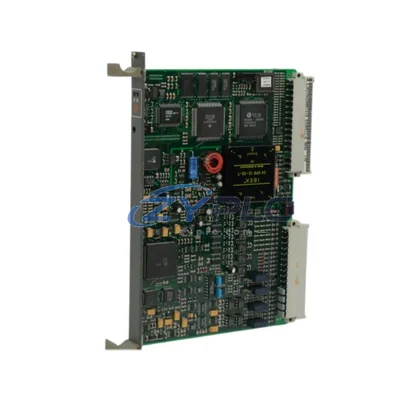
Yokogawa SSB401-53 Bus Interface for CENTUM CS3000: Control System and system integration
In modern distributed control system (DCS) deployments, the integrity of inter-module communication is foundational to system reliability, scalability, and long-term maintainability. The Yokogawa SSB401-53 ESB Bus Interface Module occupies a critical position within the CENTUM CS and CENTUM CS3000 control architecture, serving as the backbone connector between field control stations (FCS), I/O modules, and the broader supervisory network. Rather than functioning as a standalone component, the SSB401-53 is engineered to operate as a system integration node — enabling seamless data exchange across control layers while preserving the deterministic timing and fault-tolerance that industrial automation demands.
The ESB (Enhanced Signal Bus) architecture underpinning the SSB401-53 is designed to support high-speed, noise-immune communication between the CPU unit and distributed I/O sub-systems. In a typical CENTUM CS3000 installation, the SSB401-53 interfaces directly with the field control station processor — such as the CP451-10 or SCP451-11 — and coordinates signal routing across analog input modules (e.g., AAI143-S00), analog output modules (e.g., AAV141-S00), and digital I/O cards (e.g., ADV151-P00, ADV551-P00). This tightly coupled architecture ensures that process variables are acquired, processed, and actuated with minimal latency, supporting closed-loop control strategies in demanding environments.
From a system architecture perspective, the SSB401-53 enables the CENTUM CS3000 platform to maintain its modular expansion philosophy. Engineers can extend I/O capacity by adding additional node units connected via the ESB bus, without disrupting the existing control logic or requiring a full system reconfiguration. This modularity is particularly valuable in phased plant expansions, where new process units must be integrated into an existing automation backbone with minimal downtime. The SSB401-53 supports this incremental growth model by providing a stable, standards-compliant bus interface that accommodates both legacy CENTUM CS hardware and newer CS3000 generation modules.
Power distribution integrity is another dimension where the SSB401-53 contributes to overall system robustness. In conjunction with the PW482-10 power supply unit and redundant power configurations, the bus interface module ensures that voltage fluctuations or single-point power failures do not propagate across the control network. Redundant ESB bus configurations — supported by pairing the SSB401-53 with a secondary bus interface in hot-standby mode — provide the fault-tolerance required in continuous process industries such as petrochemicals, power generation, and water treatment.
Communication stability across the control hierarchy is further reinforced by the SSB401-53’s compatibility with Yokogawa’s Vnet/IP and legacy Ethernet-based supervisory networks. When integrated with the ANB10D network interface module or equivalent communication gateways, the SSB401-53 participates in a layered network topology that separates field-level bus traffic from plant-wide SCADA and historian communications. This separation reduces the risk of network congestion affecting real-time control performance — a critical consideration in high-availability applications.
For human-machine interface (HMI) integration, the SSB401-53 supports the data acquisition pipelines that feed Yokogawa’s CENTUM VP operator stations and third-party SCADA platforms. Process data collected via the ESB bus is made available to the HMI layer through the FCS data server, enabling operators to monitor and intervene in real time. The AMN34 node unit and associated terminal modules (e.g., AMN11, AMN12) work in concert with the SSB401-53 to organize I/O signals into logical groups that map directly to HMI faceplates and alarm management systems.
In terms of installation and commissioning, the SSB401-53 is designed for rack-mount deployment within standard CENTUM CS3000 control cabinets. Its compact form factor and tool-free insertion mechanism reduce installation time and minimize the risk of connector damage during field maintenance. Engineers familiar with the CENTUM CS3000 engineering environment (CENTUM VP Builder) will find that the SSB401-53 is automatically recognized upon insertion, with its configuration parameters — including bus address, redundancy mode, and diagnostic reporting — accessible through the standard system configuration interface.
Long-term maintenance efficiency is a defining advantage of the SSB401-53 within established CENTUM CS3000 installations. Its hot-swap capability allows field technicians to replace a faulty bus interface module without shutting down the associated FCS or interrupting process control. Diagnostic LEDs on the module front panel provide immediate visual indication of bus communication status, power integrity, and fault conditions — reducing mean time to repair (MTTR) and supporting predictive maintenance strategies. All SSB401-53 units supplied by ZYPLC are tested, inspected, and covered by a warranty terms confirmed during quotation, ensuring operational confidence from the moment of installation.
Product Specification Table
| Parameter |
Specification |
| Model |
SSB401-53 |
| Brand |
Yokogawa |
| Series |
CENTUM CS / CS3000 |
| System Role |
ESB Bus Interface Module |
| Bus Type |
Enhanced Signal Bus (ESB) |
| Compatible FCS |
CP451-10, SCP451-11 and CENTUM CS3000 FCS variants |
| I/O Compatibility |
AAI143-S00, ADV151-P00, ADV551-P00, AAV141-S00 and compatible I/O modules |
| Installation |
Rack-mount, tool-free insertion, CENTUM CS3000 standard cabinet |
| Redundancy Support |
Hot-standby dual bus configuration |
| Communication |
ESB internal bus; compatible with Vnet/IP supervisory network via ANB10D |
| Power Supply |
Compatible with PW482-10 and redundant power configurations |
| Operating Temperature |
0°C to 55°C (standard industrial environment) |
| Origin |
Japan |
| Warranty |
warranty terms confirmed during quotation (ZYPLC) |
System Compatibility Notes
The SSB401-53 achieves its full potential when deployed as part of a coordinated CENTUM CS3000 control system. A representative architecture begins with the CP451-10 field control station processor, which executes the control application and manages all I/O transactions via the ESB bus. The SSB401-53 bridges the CP451-10 to downstream I/O node units, including the AMN34 node module, which aggregates signals from multiple I/O cards installed in the same rack. Analog process variables — temperature, pressure, flow, and level — are acquired through AAI143-S00 analog input modules and transmitted across the ESB bus to the FCS for processing.
On the output side, the AAV141-S00 analog output module receives setpoint commands from the FCS and drives control valves, variable frequency drives, and other final control elements. Digital status signals — motor run/stop, valve open/closed, alarm contacts — are handled by ADV151-P00 and ADV551-P00 digital I/O modules, all communicating through the SSB401-53 bus interface. The SCP451-11 safety control processor can be integrated into the same cabinet architecture, sharing the ESB bus infrastructure while maintaining independent safety logic execution in compliance with IEC 61511.
At the network layer, the ANB10D Vnet/IP interface module connects the FCS to the plant-wide control network, enabling data exchange with CENTUM VP operator stations, the CENTUM VP engineering station, and third-party systems via OPC-DA or OPC-UA gateways. The PW482-10 power supply unit provides regulated DC power to the entire rack assembly, with redundant units configured for automatic failover. Terminal modules such as the AMN11 and AMN12 organize field wiring connections, simplifying cable management and reducing the risk of wiring errors during commissioning and maintenance.
Industrial Application Notes
The SSB401-53 is deployed across a wide range of process industries where the CENTUM CS3000 platform is the established control standard. In oil refinery and petrochemical applications, the module supports continuous process control of distillation columns, heat exchangers, and reactor systems, where communication reliability and redundancy are non-negotiable. Power generation facilities — including thermal, hydro, and combined-cycle plants — rely on the ESB bus architecture to coordinate turbine control, boiler management, and auxiliary systems within a unified DCS framework.
Water and wastewater treatment plants benefit from the SSB401-53’s modular expansion capability, allowing operators to add new treatment stages or monitoring points without replacing the core control infrastructure. In mining and metallurgical operations, the module’s tolerance for electrically noisy environments — characteristic of crusher drives, conveyor systems, and smelting furnaces — ensures consistent bus communication even under challenging electromagnetic conditions. Pharmaceutical and food processing facilities, where batch control and recipe management are critical, use the CENTUM CS3000 architecture with SSB401-53 bus interfaces to maintain the data integrity and audit trail requirements mandated by regulatory frameworks such as FDA 21 CFR Part 11.
Packaging and material handling lines in discrete manufacturing environments also leverage the SSB401-53 as part of hybrid DCS/PLC architectures, where the CENTUM CS3000 manages process-level control while coordinating with machine-level controllers via the Vnet/IP network. In all these applications, the SSB401-53’s role as a system integration component — connecting control, I/O, network, and power layers — makes it indispensable to system architects designing for long-term operational continuity.
Product Compatibility FAQ
Q1: Is the SSB401-53 compatible with both CENTUM CS and CENTUM CS3000 systems, and can it be used in a mixed-generation architecture?
A: Yes. The SSB401-53 is designed to operate within both CENTUM CS and CENTUM CS3000 environments. In mixed-generation installations — where legacy CS hardware coexists with CS3000 components — the SSB401-53 provides the bus interface continuity required to maintain communication integrity across module generations. Engineers should verify the specific FCS firmware version and ESB bus configuration parameters using the CENTUM VP Builder engineering tool to ensure full compatibility before deployment.
Q2: What redundancy configurations are supported, and how does the SSB401-53 behave during a bus fault or module failure?
A: The SSB401-53 supports dual-redundant ESB bus configurations, where a primary and secondary bus interface operate in hot-standby mode. In the event of a primary bus fault or module failure, the system automatically switches to the secondary bus interface without interrupting control execution or causing process upsets. The switchover is transparent to the FCS control application and is logged in the system event journal for maintenance review. Hot-swap replacement of a failed SSB401-53 can be performed without shutting down the FCS, minimizing process downtime.
Q3: What does the warranty terms confirmed during quotation cover, and what support is available for installation and commissioning?
A: All SSB401-53 modules supplied by ZYPLC are covered by a warranty terms confirmed during quotation against manufacturing defects and functional failures under normal operating conditions. The warranty covers module replacement or repair at no additional cost within the warranty period. ZYPLC’s technical team provides pre-sales application support, including architecture compatibility review and configuration guidance, as well as post-sales assistance for installation, commissioning, and troubleshooting. Customers can reach the support team at +86 19859288691 or plc.sales@zyplc.com for prompt assistance.